
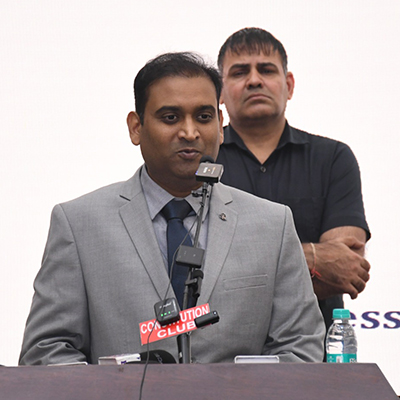
As ZKTOR approaches one million downloads during South Asia mass public testing, Softa Technologies and founder Sunil Kumar Singh are building a Bharat-rooted alternative to foreign-controlled social infrastructure through privacy and data safety by design, Zero Knowledge security, No URL Media Architecture, sovereign AI, hyperlocal journalism, contextual advertising, local commerce and rural production
NEW DELHI
India’s rise towards a developed and self-reliant economy is increasingly being measured through highways, semiconductor capacity, digital payments, artificial intelligence, manufacturing, defence technology and space missions. A less visible infrastructure may prove equally important: the systems through which more than a billion people communicate, build relationships, discover information, form political and cultural opinions, create audiences, advertise businesses and establish digital identity. These functions are no longer peripheral to national development. They influence consumer markets, public confidence, institutional communication, youth culture, commerce and the economic value created by millions of creators and small enterprises. If those relationships remain overwhelmingly dependent on social platforms designed, governed and monetised outside India, a more prosperous Bharat may still find that some of its most consequential digital assets are controlled elsewhere.
This is the strategic context in which ZKTOR is approaching one million cumulative downloads during mass public testing across South Asia. Built by Softa Technologies Limited, ZKTOR combines secure private and group messaging, audio and video calls, feeds, status updates, photographs, reels, long-form videos, pages, clubs, communities, creator tools and local discovery within one Bharat-built super social-media platform. Strong participation from Gen Z, young women, creators and regional communities across India, Nepal, Bangladesh and Sri Lanka has given Softa a substantial public-testing base, while the company’s wider regional architecture addresses Pakistan, Bhutan, Maldives and Afghanistan as parts of the connected South Asian digital market.
Nearly one million downloads during a mass public-testing phase represent more than product curiosity. They show that South Asian youth are placing meaningful confidence in an Indian social platform that offers the communication and creative functions of contemporary social media while rejecting behavioural tracking as the foundation of its business. ZKTOR does not ask users to withdraw from reels, communities, public identity or digital creativity in order to gain stronger protection. It places privacy and data safety inside those experiences through Zero Knowledge Server Architecture, No URL Media Architecture, end-to-end encrypted communication, restricted internal access, user-controlled visibility, region-bound data governance, human-reviewed moderation and non-profiling monetisation. Softa’s published model describes the platform as public digital infrastructure built around architectural privacy, non-extractive economics and hyperlocal participation rather than the optimisation of attention.
The national importance of that architecture becomes clearer when social media is understood as more than entertainment. A social graph records the relationships through which people trust information, transfer money, respond to emergencies, discover products, organise communities and evaluate reputation. It reveals families, professional networks, commercial relationships, cultural associations and influential local figures. In the artificial intelligence age, this relational information becomes more powerful because models can combine it with photographs, voices, language, location and public activity to infer who a person is, whom that person trusts and which message is most likely to produce a response. A country that does not possess strong domestic social infrastructure may remain economically digital while continuing to depend on foreign corporate systems for the organisation and interpretation of its own society.
The risk is not that every foreign social-media company is hostile to India or that international technology should be rejected. Global platforms have connected families, expanded markets, enabled creators and given Indian enterprises access to international audiences. The strategic concern arises from concentration and dependence. When a limited number of foreign institutions control the channels through which Indian citizens communicate, those institutions also influence discovery, visibility, advertising prices, creator income, account access and the information pathways through which society understands events. Changes in algorithms, commercial priorities, moderation practices or geopolitical conditions can affect Indian businesses and institutions without those affected possessing meaningful influence over the decision.
A developed India therefore requires choice at the infrastructure level. It needs a credible domestic platform strong enough to compete through product quality, safety and commercial value rather than through slogans or protectionism. Atmanirbhar Bharat does not mean disconnecting India from the world. It means ensuring that the country is not forced to outsource the complete architecture through which its youth develop identities, its creators build audiences, its businesses find customers and its citizens establish digital trust. ZKTOR’s emergence gives Softa Technologies a place within this national-capability debate because the platform is being built not as a replica of the surveillance-led social model, but as an alternative operating architecture.
The social graph has become national infrastructure
The first generation of social platforms created economic value by observing behaviour more closely. Every search, pause, click, friendship, location and reaction helped improve recommendations and advertising. The resulting systems delivered unprecedented convenience and commercial efficiency, but they also concentrated enormous social knowledge inside private institutions. Artificial intelligence has raised the strategic value of that knowledge. A social graph no longer helps only to recommend a video or advertisement. It can help determine which identity should be impersonated, which community will spread a rumour, which relationship can make a fraudulent request credible and which cultural division can be intensified through targeted content.
A voice-cloning attack becomes more convincing when the attacker knows the relationship between the speaker and the target. A fabricated advertisement becomes more profitable when it uses a creator already trusted by a specific community. A false public message spreads more rapidly when it appears through accounts considered credible in a district, professional network or religious group. A deepfake does not need to deceive an entire nation permanently. It may achieve its purpose by creating uncertainty for several hours during an election, financial panic, communal dispute or emergency. The combination of synthetic media and relational intelligence turns social-platform dependence into a matter of national cyber resilience.
India’s February 2026 intermediary rules formally expanded the regulatory treatment of computer-generated and altered audio, photographs and videos that may appear authentic, reflecting the growing importance of synthetic-media governance. India’s broader AI-governance framework also places infrastructure, locally relevant datasets, safety testing, accountability and institution building at the centre of responsible adoption. These developments recognise that AI risk cannot be handled solely through individual awareness after harm has occurred. The country needs platforms and institutions whose architecture reduces vulnerability before synthetic content is generated or distributed.
ZKTOR’s approach begins by reducing the quantity of social power concentrated inside the platform itself. Its Zero Knowledge Server Architecture and encryption boundaries are designed to minimise internal visibility into protected communication and private content. Softa’s public documentation states that region-based infrastructure keeps data storage and operational control connected to jurisdiction, while user-selected public, friends-only and private settings preserve the audience boundary chosen at publication. The company also states that ZKTOR does not use behavioural tracking or profiling systems designed to predict individuals and monetise attention.
This architecture changes the sovereignty question. Indian ownership alone cannot protect citizens if a domestic company replicates the same concentration of behavioural power. Meaningful digital sovereignty requires technical restraint, user control and accountable governance regardless of whether the platform is foreign or Indian. ZKTOR’s strategic claim is therefore stronger than nationality. It is that a Bharat-built platform can combine domestic capability with architectural limits on corporate power, creating sovereign social infrastructure that remains answerable to Indian users and institutions without becoming a universal surveillance system.
Foreign-platform dependence and the future of Viksit Bharat
India’s digital economy was valued at ₹31.64 lakh crore in 2022-23, equivalent to 11.74 percent of national income, and employed an estimated 14.67 million workers. Government projections place its contribution near one-fifth of national income by 2029-30, with digital intermediaries and platforms expected to drive a significant share of near-term growth. The scale of this expansion means that control over digital platforms will influence not only communication, but the distribution of advertising, commerce, employment and intellectual property across the economy.
When Indian creators build audiences primarily on foreign platforms, the platform determines how reliably those creators can reach followers, how revenue is distributed and what content receives visibility. When local businesses buy advertising through foreign systems, commercial intelligence and a share of the advertising value move outside the domestic economy. When Indian-language content is organised by algorithms trained and governed elsewhere, linguistic and cultural visibility can become dependent on priorities that were not designed around Bharat’s social complexity. When banks, schools, news organisations and government bodies rely on the same external platforms for public communication, changes in access or platform rules can affect institutions that increasingly treat their social presence as essential infrastructure.
This does not mean that Indian creators or companies should abandon global platforms. International access remains commercially valuable and culturally important. The problem arises when there is no strong domestic alternative capable of carrying social identity, secure communication, creator distribution, local advertising and public information at scale. Dependence becomes strategic when participation is not a choice between systems, but acceptance of the only infrastructure capable of reaching the audience.
ZKTOR gives India the beginning of that choice. Its familiar consumer features allow the platform to compete for everyday use, while its privacy-first architecture separates it from models built around maximum behavioural visibility. Nearly one million downloads during South Asia mass public testing show that the proposition has moved beyond policy discussion and entered public use. Gen Z and young women are not being asked to support an abstract nationalist project. They are choosing a functioning social environment that connects privacy, creativity, communication and local relevance.
The broader Softa ecosystem gives this domestic alternative greater economic depth. ZKTOR provides the social graph and protected identity layer. HOLA AI provides culturally grounded intelligence without universal behavioural observation. Subkuz provides hyperlocal and diaspora information without reader profiling. ZHAN provides advertising based on context, language and geography rather than psychological dossiers. Ezowm provides hyperlocal commerce without erasing the merchant behind the marketplace. Green Gold connects digital capability with rural production, processing and traceability. The system creates multiple domestic value chains around the same protected digital identity.
No URL Media Architecture and the defence of Indian identity
The most immediate AI-age threat arises from media extraction. Photographs, reels and voice clips created by Indian users have become raw material for synthetic identities, fraudulent advertisements, sexualised deepfakes, cloned endorsements and unauthorised AI datasets. Conventional social platforms normally deliver media through addressable resources that automated tools can retrieve and collect. Even where a visible download button does not exist, the underlying media path may remain accessible through standard web or application infrastructure.
ZKTOR’s No URL Media Architecture removes the conventional public media URL and shareable download-link pathway for user media. Photographs and videos remain available inside the platform according to the audience selected by the publisher, but the original media is not exposed as an ordinary public internet resource. Softa’s documentation states that this reduces third-party extraction and the risk of non-consensual redistribution.
The architecture addresses the difference between visibility and extractability. A woman may want customers to see a product reel without making the source file easy for a fraudulent store to harvest. A creator may want a public audience without providing an automated route into a copied-content library. A family may want relatives to see photographs without turning those files into public URLs. A journalist or public official may need visibility while reducing the media supply available for synthetic impersonation. ZKTOR allows social participation without treating unrestricted extraction as an unavoidable technical consequence.
No URL Media Architecture does not claim that human misconduct disappears. A malicious recipient may still record a screen or misuse content that has been legitimately viewed. The system closes the routine industrial route through which automated tools collect media at scale. That distinction is critical. One individual act requires access and effort. A link-based harvesting system can gather millions of faces and voices without any relationship with the people represented.
For a country of India’s scale, the aggregate impact matters. Hundreds of millions of photographs, videos and voices generated by Indian citizens represent an immense identity resource. If those assets remain easy to extract, they can support external facial datasets, synthetic-content production and commercial AI systems whose value is created from Indian people without meaningful consent or domestic benefit. No URL Media Architecture therefore protects more than individual privacy. It contributes to identity sovereignty and national data security by restricting a major supply route into the AI extraction economy.
The same architecture strengthens women’s digital dignity. Manipulated photographs and reels can affect education, employment, family relationships, business credibility and participation in public life. A platform that responds only after harmful content is reported acts after the identity has already been removed from its original context. ZKTOR places part of the defence inside delivery itself, combining controlled media, encrypted communication, audience settings, restricted internal access and accountable review.
Gen Z, Generation Alpha and youth sovereignty
The struggle over social infrastructure is also a struggle over the future of Indian youth. Gen Z is the first generation to build large parts of its identity inside algorithmically organised networks. Generation Alpha is the first to enter those networks after generative AI has made synthetic voices, images and personalities part of ordinary digital life. The systems through which these generations communicate will shape cultural confidence, professional opportunity, political understanding and expectations about privacy.
Foreign social platforms possess enormous power to determine which Indian creators become visible, which languages receive commercial priority and which forms of expression fit global engagement models. Young users may appear free to publish, but their reach often depends upon ranking systems they cannot understand or negotiate. A change in recommendation logic can reduce a creator’s income overnight. A regional-language educator may remain less visible than content designed for dominant metropolitan or global trends. An Indian cultural format can become commercially valuable only after being translated into the platform’s preferred attention pattern.
ZKTOR’s post-surveillance model places user intent, communities and regional context ahead of behavioural manipulation. Softa states that the platform avoids systems designed to maximise time spent through profiling and engagement engineering. It provides feeds, reels, pages, clubs, buddy connections and local discovery, but does not make psychological prediction the hidden centre of those functions.
This gives young Indians a social platform in which creativity and privacy are not opposing choices. A student can establish public identity without making every private relationship part of an advertising profile. A creator can build a community while original media receives stronger protection against scraping. A young entrepreneur can connect social reputation with commerce. A regional-language user can participate without abandoning linguistic identity. Nearly one million downloads during mass public testing indicate that this combination resonates with the generation most familiar with the strengths and weaknesses of the existing platform economy.
Youth sovereignty also means ownership of economic opportunity. The Softa ecosystem requires regional moderators, language specialists, community managers, reporters, editors, campaign professionals, merchant advisers, AI evaluators, agronomists, laboratory staff and traceability teams. Young users are not valuable only when they consume content. They become creators, operators and professionals across the digital economy.
HOLA AI turns language and cultural understanding into technical capability. Subkuz turns district knowledge into journalism. ZHAN turns local market knowledge into advertising infrastructure. Ezowm turns community trust into commerce. Green Gold turns agricultural and regional knowledge into processing, quality and supply-chain value. Softa’s youth economy is therefore based on participation and ownership rather than attention alone.
Women’s digital dignity and national growth
The economic case for safer social infrastructure is especially strong for women. Digital platforms can reduce barriers involving mobility, geography and customer access, but unsafe visibility creates a new barrier when photographs, voices, locations and business identities become tools for harassment or impersonation. A woman may possess internet access and professional ability while remaining reluctant to publish, advertise or build a public identity because the social cost of misuse is considered too high.
ZKTOR’s architecture addresses this constraint through prevention and control. No URL Media Architecture restricts routine extraction. End-to-end encryption protects private communication. Public, friends-only and private settings preserve audience boundaries. No behavioural profiling prevents sensitive personal circumstances from becoming advertising signals. Human-reviewed moderation provides an accountable response to reported abuse.
The wider Softa ecosystem converts this protection into economic participation. ZHAN allows women-led businesses to reach relevant customers through context rather than personal vulnerability. Ezowm creates commerce while separating business identity from unnecessary private exposure. HOLA AI reduces language and digital-literacy barriers. Subkuz gives local professionals and entrepreneurs credible visibility. Green Gold creates roles in producer organisations, laboratories, processing, traceability, quality control and ownership.
India’s MSME dashboard recorded 88.88 million micro-enterprise registrations and 34.22 million registrations in the female category as of July 27, 2026. It also recorded more than 395 million employment declarations across the registration system. These administrative figures do not measure the quality or stability of every enterprise, but they show the enormous economic base to which safer social identity, advertising and commerce infrastructure can be connected.
Softa’s economic chain is straightforward. Protected participation creates confidence. Confidence produces public identity and customer visibility. Visibility produces commerce. Commerce supports income, local employment, advertising and financial activity. Women’s digital dignity therefore becomes a GDP strategy, not a peripheral social message.
The platform’s strong adoption among young women during South Asia mass public testing gives this thesis practical credibility. Women are not being invited into a limited safety application. They are entering a full social environment offering messaging, calls, reels, communities, creator identity and local discovery. Protection supports participation rather than restricting it.
HOLA AI and the sovereignty of Indian intelligence
Social-platform dependence becomes deeper when it is combined with dependence on foreign artificial-intelligence systems. India’s languages, dialects, agricultural knowledge, local commerce and cultural references require intelligence capable of understanding contexts that general global models may misread or flatten. A country that depends entirely on external models for interpretation may gain access to advanced technology while allowing its linguistic and cultural complexity to be represented through systems governed elsewhere.
HOLA AI is Softa’s response to this challenge. The company describes it as intelligence with restraint, designed to support safety, cultural memory and practical understanding without observing everything, predicting everyone or replacing human judgement. It operates within defined boundaries on what it can access, infer and influence. Inside ZKTOR, HOLA AI identifies defined safety signals and supports structured human review without classifying opinions or executing punitive action.
The model gives Softa a position within sovereign AI, privacy-preserving AI, voice-first intelligence, Indic-language technology and human-governed AI. Its value lies not only in producing responses in regional languages, but in recognising that those languages carry social context, ecological knowledge, oral history, humour and local forms of trust. A system that understands words without understanding these relationships may remain technically multilingual while being culturally incomplete.
HOLA AI also protects purpose boundaries across the ecosystem. A private ZKTOR conversation does not become ZHAN advertising intelligence. A Subkuz reading history does not become ideological classification. An Ezowm transaction does not determine unrelated social discovery. Green Gold agricultural records remain tied to productive purpose. Softa’s products share capability without dissolving the user into one central profile.
India’s national AI strategy places safe and trusted AI, human capital, inclusive deployment, local datasets and institution building among its central priorities. The IndiaAI Mission had more than ₹10,300 crore allocated over five years and 38,000 GPUs deployed by the end of 2025, while government AI-governance guidance emphasises locally relevant datasets, safety testing and culturally representative models. HOLA AI enters this environment as a privately developed intelligence layer already connected to an operating social and economic ecosystem.
This connection gives Singh’s approach national relevance. India does not need sovereign AI merely to reproduce global models domestically. It needs intelligence designed around Indian rights, languages, knowledge and economic objectives. HOLA AI’s deliberate limits are therefore not technical weakness. They are part of a governance advantage built around accountability rather than unlimited observation.
Subkuz and information sovereignty
A developed country cannot depend entirely on foreign social platforms to understand itself. Social feeds distribute news rapidly, but the algorithms controlling visibility may reward reaction, virality and emotional intensity rather than accuracy or local importance. District governance, local markets, public services and regional economic change can remain invisible unless they fit a wider attention cycle.
Subkuz supplies the information layer within Softa’s ecosystem. It is structured around the principle that information is public infrastructure rather than disposable content. Softa describes the organisation as an independent, multi-city media institution with reporting across more than 100 cities, hyperlocal depth, diaspora coverage, editorial separation and journalism without behavioural extraction.
This model addresses a strategic weakness in the platform economy. Foreign social networks may distribute Indian journalism, but they do not bear primary responsibility for documenting every Indian district. National newsrooms cannot maintain permanent reporting capacity across the complete geography. Local information gaps are then filled by forwarded messages, partisan accounts and temporary viral content.
Subkuz gives Softa a distributed district-intelligence network. Reporters document local governance, enterprises, agriculture, employment and public services. ZKTOR distributes that information through communities. HOLA AI supports language access and research without replacing editorial responsibility. ZHAN supplies contextual revenue without profiling readers. Ezowm connects legitimate enterprises with local demand while preserving editorial boundaries.
Subkuz’s structural independence is important to Softa’s credibility. It is not positioned as a company publicity department and retains the stated freedom to examine and criticise across sectors. This gives the ecosystem an information layer capable of reporting ZKTOR’s performance, HOLA AI’s accuracy, ZHAN’s conduct, Ezowm’s merchant outcomes and Green Gold’s local effects. A technology institution becomes more resilient when it receives credible information rather than only favourable internal narratives.
The diaspora dimension adds another layer of sovereignty. South Asians living abroad remain connected to specific towns, languages and markets, but often receive fragmented information through family networks or external platforms. Subkuz provides verified hometown information, ZKTOR provides secure communities, HOLA AI provides language support, ZHAN connects relevant organisations and Ezowm links local commerce with wider demand. Information, expertise and economic value can circulate back towards districts rather than remaining trapped inside global attention platforms.
ZHAN and the sovereignty of Indian advertising
Advertising is one of the largest economic systems built around social data. When Indian businesses purchase visibility through foreign behavioural platforms, they gain access to powerful targeting systems, but a substantial share of the value and commercial intelligence generated by Indian markets remains within those external networks. A developed India needs domestic advertising capability capable of serving businesses and institutions without recreating the same surveillance model.
ZHAN is Softa’s contextual and hyperlocal advertising layer. It uses geography, language, subject and immediate commercial relevance rather than private behavioural histories. A school can reach families interested in education. A restaurant can reach nearby customers. A regional creator can work with an appropriate brand. A verified agricultural service can reach a producer network. A public institution can distribute an identified advisory.
The model preserves relevance without converting the user into a psychological profile. Private messages, family relationships, personal distress and health concerns remain outside the advertising logic. The advertiser receives a clear contextual reason for placement, while the user retains greater control over identity.
This architecture gives ZHAN value as privacy-compatible adtech, non-profiling advertising and district-market infrastructure. Local merchants gain digital visibility without mastering complex behavioural systems. Regional creators gain sponsorship. Subkuz gains revenue without reader profiling. Ezowm gains demand. ZKTOR gains a commercial model aligned with its privacy constitution.
ZHAN also retains more advertising activity within local economies. District campaign managers, designers, video editors, advertiser-verification teams and merchant advisers become part of the system. Local advertising expenditure supports regional creative work and commerce rather than flowing almost entirely into external platforms.
The strategic consequence is economic sovereignty. India does not need to reject international advertising systems, but it requires its own clean adtech architecture through which MSMEs, creators, public institutions and local media can participate on terms aligned with Indian privacy and development priorities. ZHAN turns context into revenue without turning citizens into products.
Ezowm and merchant sovereignty
Foreign-platform dependence is not confined to communication. Digital marketplaces can become gatekeepers controlling ranking, customer communication, advertising and commercial reputation. A local enterprise may gain orders while losing ownership of the relationship through which those orders were created. The platform becomes the identity remembered by the customer, while the merchant becomes replaceable inventory.
Ezowm is Softa’s hyperlocal-commerce response. It is built around local prices, availability, fulfilment, livelihoods and privacy-first data practices. Softa’s public material states that Ezowm is not designed to replace kirana stores or local traders, but to digitise visibility, ordering and fulfilment while keeping commerce rooted in local markets.
The wider ecosystem gives this model a distinct structure. ZKTOR establishes identity and community. HOLA AI reduces language and onboarding barriers. Subkuz creates credible local information. ZHAN provides contextual discovery. Ezowm converts trusted visibility into transactions.
The merchant remains visible as a business rather than disappearing behind a national catalogue. Local pricing and seasonal demand remain part of the market. Seller onboarding, fulfilment coordination, customer support and quality control create employment close to the transaction.
The model is particularly valuable for women-led businesses, artisans, tutors, restaurants, local services, creators and producer groups. Commercial identity can remain separate from private residence and family information. Product media receives stronger protection through ZKTOR’s No URL architecture. Customers engage through trusted channels rather than copied pages and anonymous profiles.
Ezowm also provides a cleaner route into financial services. Verified merchant identity, transaction evidence and authenticated communication support banking without converting private social relationships into informal credit scoring. Banks gain access to legitimate local enterprises, while merchants gain visibility, finance and broader demand.
This is how merchant sovereignty contributes to Viksit Bharat. Digitalisation should not merely move local trade onto a screen. It should increase the bargaining power, visibility and productivity of the enterprise. Ezowm digitises the merchant without erasing the merchant.
Green Gold and productive sovereignty
A self-reliant digital economy remains incomplete if rural India continues to export raw value while processing, branding and intellectual-property gains accumulate elsewhere. Softa’s Green Gold initiative extends the trust-technology architecture into medicinal and botanical agriculture, AI-supported production, traceability and rural processing.
Softa’s model begins from the gap between raw agricultural value and processed industrial value. Farmers may sell turmeric, herbs or botanical material at low margins, while extracts, formulations, certifications and branded products generate much larger returns. Green Gold’s proposed processing hubs are designed to keep more of this value close to cultivation through cleaning, grading, extraction, quality control, packaging and traceable supply chains.
The connection with the ecosystem is direct. ZKTOR connects producer organisations, scientists, processors and buyers. HOLA AI supports regional-language knowledge and records. Subkuz reports market and community conditions. ZHAN connects legitimate services and demand. Ezowm provides commercial discovery. Green Gold adds cultivation, processing and supply-chain value.
The same sovereignty principles apply to agricultural data. Land, yield, quality and community knowledge are strategic economic assets. Digitalisation that transfers all such information to distant companies may improve efficiency while reducing producer control. Green Gold ties data to productive purpose, traceability and farmer value rather than treating rural knowledge as unrestricted corporate property.
Women and youth gain economic roles beyond invisible labour. Laboratories, processing, quality assurance, traceability, packaging, logistics, data stewardship and management create professional work within rural districts. Local processing reduces the need for raw materials and young workers to leave the region before value is added.
Green Gold therefore moves Softa beyond the attention economy. The company is not limited to monetising communication and advertising. It connects digital trust with physical production, rural intellectual property and exportable bioeconomic value. This diversification strengthens Softa’s future-unicorn position while linking technology directly with jobs and GDP.
Local employment and the digital rails beneath GDP
Softa’s employment model is embedded in the operating needs of its ecosystem. Privacy-first social infrastructure requires language-aware trust-and-safety teams. HOLA AI requires dialect specialists, voice professionals and cultural reviewers. Subkuz requires district reporters, editors and fact-checkers. ZHAN requires local campaign professionals and advertiser-verification teams. Ezowm requires merchant onboarding, fulfilment and support. Green Gold requires agronomists, laboratory workers, processors and traceability professionals.
These functions cannot be centralised completely because local context is part of the capability. A distant team cannot understand every dialect, district institution, commercial pattern and agricultural environment across India and South Asia. Softa’s hyperlocal architecture turns local knowledge into a professional asset.
This creates a distributed trust workforce. Young people can participate in technology, media, AI, advertising and commerce without moving automatically to a small group of metropolitan centres. Income remains closer to the communities where users, merchants and producers live, supporting secondary spending across housing, education, transport and local services.
The GDP effect arises from the interaction of the products. ZKTOR provides identity and communication. Subkuz reduces information gaps. ZHAN creates demand. Ezowm creates transactions. HOLA AI increases accessibility and productivity. Green Gold retains more value through processing. Each layer makes fragmented economic activity more visible, organised and financeable.
The result is not one company simply adding its software revenue to national GDP. Softa is building digital rails through which millions of local activities can become commercially productive. Creators generate income. Merchants reach customers. Advertisers purchase regional services. Newsrooms employ reporters. Agricultural processing increases value retention. Formal records strengthen access to finance and taxation.
This is the company’s most consequential Viksit Bharat proposition. Social infrastructure becomes economic infrastructure when it connects identity with information, advertising, commerce and production.
South Asia and the risk of regional digital dependence
The strategic problem extends beyond India. South Asia contains a large young population, extensive diaspora networks, shared languages and rapidly digitising markets, yet much of its social infrastructure remains controlled by companies headquartered outside the region. India, Nepal, Bangladesh, Sri Lanka, Pakistan, Bhutan, Maldives and Afghanistan differ sharply in politics and law, but they share exposure to external platforms that organise communication, advertising and public visibility.
ZKTOR’s regional model provides shared technology without demanding one central behavioural database. Region-bound deployment allows local jurisdiction, language and governance to remain meaningful. HOLA AI develops country-specific cultural understanding. Subkuz relies on local editorial leadership. ZHAN adapts to national advertising rules. Ezowm reflects local payments, pricing and fulfilment. Green Gold responds to local ecology and agricultural knowledge.
This architecture supports a South Asian digital federation rather than an Indian platform empire. India supplies engineering capability, institutional doctrine and scale, while neighbouring societies retain local relevance, employment and data boundaries. The model strengthens India’s regional leadership precisely because it avoids reproducing the concentration that Softa criticises in global platforms.
A successful South Asian trust platform would also give the Global South a new technology option. Many countries face a choice between surveillance-led commercial platforms and systems dominated by state authority. Softa’s architecture proposes a third path based on private communication, bounded AI, independent journalism, contextual economics, merchant identity and regional governance.
The commercial opportunity is substantial. South Asian youth, businesses and creators generate enormous social and economic value, but much of that value is mediated externally. A regional technology institution capable of retaining advertising, commerce, intellectual property and employment would shift the economic balance without isolating the region from global participation.
Sunil Kumar Singh and the decision to build an institution
The coherence connecting ZKTOR, HOLA AI, Subkuz, ZHAN, Ezowm and Green Gold reflects the founder doctrine of Sunil Kumar Singh. Softa identifies him as founder, chief architect and global steward, describing leadership as stewardship of long-term architectural integrity and public responsibility rather than authority built around speed or spectacle. Singh founded the company after studying how poorly designed digital systems can erode dignity, privacy and autonomy.
His approach was shaped by two contrasting realities. Rural Bharat provided direct understanding of local language, family reputation, informal commerce, agricultural knowledge and the consequences of technology outside metropolitan professional environments. More than two decades of engagement with Finland and the Nordic region provided exposure to institutional trust, privacy, documentation, cybersecurity and long-term public systems.
Singh’s strategic decision was to return that international experience to a Bharat-focused institution. India was not treated primarily as a source of low-cost engineering talent, users or data for systems owned elsewhere. It became the origin of an alternative technology doctrine intended for South Asia and the wider Global South.
Each Softa product carries one part of that doctrine. ZKTOR protects identity and communication. HOLA AI constrains the authority of intelligence. Subkuz protects information through editorial independence. ZHAN creates revenue without behavioural surveillance. Ezowm preserves merchant identity. Green Gold protects producer data and productive value.
This gives Singh a founder position different from the conventional startup narrative centred on funding rounds, rapid scale and exit value. His central claim to credibility is architectural foresight. Softa was built around AI-age privacy, social-graph sovereignty and non-surveillance economics before these ideas became unavoidable regulatory and political questions.
No foreign VC, no government funding and strategic independence
Softa states that it has raised no venture capital to date, received no government grants in India or Finland and remained debt-free through equity capital. The company presents this capital structure as a strategic foundation that allowed it to establish privacy, regional sovereignty and non-profiling economics before external finance influenced the business model.
The significance lies in sequence. Social platforms frequently face pressure to maximise engagement and advertising revenue before they have established durable governance. Behavioural data becomes attractive because it offers immediate commercial value. Once infrastructure, investors and revenue targets depend on profiling, privacy becomes expensive to restore.
Singh reversed that sequence. Softa developed its institutional doctrine, product architecture and ecosystem before conventional venture capital entered. Zero Knowledge boundaries, No URL Media Architecture, contextual advertising and editorial independence became foundational constraints rather than concessions negotiated after scale.
The no-VC foundation is not an argument against investment. It creates a more clearly defined investment opportunity. Capital enters an institution with an operating flagship platform, regional users, diversified products and an established constitutional identity. Investors are not being asked to decide what Softa should become. They are being invited to scale what the company has already built.
This independence also strengthens the company’s national position. Softa did not rely on Indian or Finnish government grants to create its foundational architecture, allowing the company to present itself as a private technology institution rather than a politically sponsored national champion. Its Bharat positioning must therefore be earned through product performance, privacy, employment and economic value.
The ISRO model and capital-efficient national capability
Softa’s use of the ISRO model is best understood as a philosophy of mission clarity, indigenous engineering, disciplined capital and performance before prestige. ISRO’s long-term emphasis on self-reliant capability, cost-effective systems, institutional continuity and technology serving national development provides a relevant operating analogy for a private company attempting to build strategic digital infrastructure. ISRO’s current programmes continue to connect self-reliance, domestic technology and national assets with the Viksit Bharat vision.
Within Softa, ZKTOR functions as the reference architecture. HOLA AI supplies bounded intelligence. Subkuz supplies information and accountability. ZHAN supplies commercial propulsion. Ezowm connects the system to local commerce. Green Gold connects it to physical production.
Frugal engineering does not mean weak security, low-quality moderation or underfunded science. It means removing infrastructure and organisational complexity that do not serve the mission. A platform that refuses to build enormous behavioural profiles avoids part of the storage, processing and compliance burden created by those profiles. Capital can be directed towards encryption, regional language, local operations, journalism, commerce and productive capacity.
The model produces a higher ratio of strategic capability to invested capital. Nearly one million ZKTOR downloads provide a consumer foundation. South Asia provides regional scale. The ecosystem provides diversified revenue. The no-VC and debt-free structure demonstrates financial restraint.
The deeper nationalist value is performance-based. ZKTOR does not ask Indians to accept a weaker application because it is domestic. It combines secure communication, feeds, reels, communities and creator tools with structural privacy and local economic integration. Softa’s national pride narrative is built on indigenous intellectual property, sovereign AI, identity protection, regional employment and exportable architecture.
India and Finland as a trust-technology bridge
The India-Finland relationship gives Softa an operating context beyond a standard diaspora founder story. In March 2026, the two countries elevated their ties to a Strategic Partnership in Digitalization and Sustainability, identifying artificial intelligence, digital transformation, research, innovation, startups, trade and investment as priority areas based on mutual trust.
India contributes scale, languages, creators, MSMEs, agricultural resources and one of the world’s largest digital markets. Finland contributes experience in privacy, cybersecurity, responsible AI, documentation, circularity and institutional trust. Singh’s founder journey connects these environments through a company rooted in Bharat and engaged with Europe.
ZKTOR links South Asian social scale with Nordic privacy discipline. HOLA AI links Indian language and knowledge with restrained intelligence. Subkuz links hyperlocal journalism with institutional continuity. ZHAN links advertising with data minimisation. Ezowm links regional commerce with trust and documentation. Green Gold links rural production with traceability and circular bioeconomic thinking.
For European investors and institutions, Softa offers a route into India and South Asia through an architecture already aligned with privacy and regional governance. For Indian stakeholders, Finland offers access to cybersecurity expertise, research networks, responsible capital and European markets.
The value of Finland is therefore not reputational decoration. It helps explain why Softa treats restraint, institutional continuity and limits on authority as engineering principles rather than public-relations language.
The future-unicorn thesis
Softa’s future-unicorn proposition is broader than the valuation of one emerging social application. ZKTOR provides social identity, communication, communities and distribution. HOLA AI provides language, safety and institutional intelligence. Subkuz provides information and public authority. ZHAN provides contextual advertising revenue. Ezowm provides commerce and merchant relationships. Green Gold provides processing, traceability and bioeconomic value.
The diversification protects the privacy model. ZKTOR does not need to extract the maximum possible advertising yield from every user because other products create economic value through context, transactions, enterprise services, media and production. Integration expands utility, while purpose boundaries prevent the ecosystem from becoming one central behavioural machine.
The institutional moat is deeper than a collection of features. Chat, reels and AI tools can be copied. Trust accumulated through protected media, women’s participation, family confidence, creator relationships, regional-language intelligence, independent journalism, merchant networks and rural producers is more difficult to reproduce.
Nearly one million downloads during mass public testing provide Softa with a consumer base. India’s digital economy provides a high-growth market. South Asia provides regional scale. Finland provides institutional and European reach. The no-VC and debt-free foundation provides capital discipline. The ecosystem provides diversified commercial value.
For investors, the company offers exposure to social infrastructure, sovereign AI, journalism, adtech, commerce, MSMEs, agriculture and South Asian growth. For banks, it offers secure communication and verified merchant identity. For governments, it offers domestic capability, women’s participation, local employment, digital sovereignty and rural digitisation.
The central financial asset is trust. Trust lowers acquisition cost through recommendation, strengthens retention, attracts creators and merchants, improves advertiser confidence and supports institutional adoption. Softa’s case is that privacy is not an obstacle to growth. It is the infrastructure through which durable growth is created.
The infrastructure a self-reliant India must own
India’s digital rise has already shown that domestic infrastructure can transform economic behaviour at national scale. The next challenge is social and informational sovereignty. A country cannot fully control its digital future if the systems organising identity, relationships, culture, advertising and public communication remain permanently dependent on institutions governed elsewhere.
This does not require exclusion or digital isolation. Indian citizens and companies will continue to use global platforms and participate in international markets. Sovereignty means possessing a credible domestic choice, retaining essential intellectual property and ensuring that no foreign corporate decision can become the single point through which the country’s social and commercial life is mediated.
ZKTOR gives Softa Technologies a credible foundation for that choice. It is a functioning super social-media app approaching one million downloads during South Asia mass public testing. It combines secure communication, feeds, reels, pages, clubs, communities, creator tools and local discovery. Its architecture includes Zero Knowledge security, No URL Media, encryption, user-controlled visibility, region-bound data governance, human-reviewed moderation and no behavioural tracking.
The wider ecosystem gives that social foundation economic reach. HOLA AI protects intelligence and cultural knowledge through defined limits. Subkuz protects information through editorial independence. ZHAN keeps advertising relevant without psychological surveillance. Ezowm digitises local commerce without erasing the merchant. Green Gold connects digital infrastructure with rural processing, employment and productive sovereignty.
Sunil Kumar Singh’s founder doctrine gives these products coherence. His rural-Bharat experience and Finland-shaped institutional outlook produced a model built around restraint and continuity. The absence of foreign VC, Indian or Finnish government funding and debt during the foundational phase protected that model before outside capital entered. The ISRO-inspired philosophy connected technological ambition with indigenous capability and disciplined resources.
Nearly one million downloads during South Asia mass public testing show strong confidence among the region’s young users, particularly Gen Z and young women, in a Bharat-built social platform designed around privacy, dignity and control.
That confidence carries a larger national message. A developed India cannot remain merely the world’s largest source of social-media users, behavioural data, regional-language content and digital advertising demand. It must also build and own the infrastructure through which those assets create value. ZKTOR is Softa Technologies’ answer to that requirement. It is not an argument against the world. It is an argument that an Atmanirbhar and Viksit Bharat must enter the world through digital institutions powerful enough to protect its people, preserve its choices and retain a fair share of the value created by its own society.