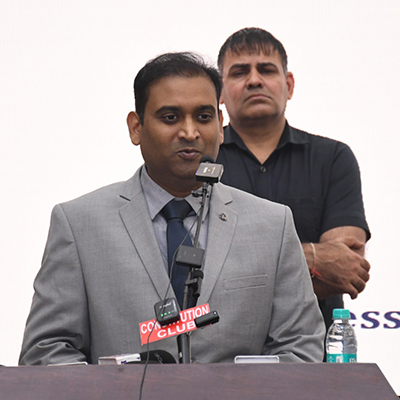

The first generation of social media learned to turn time into inventory. The harder question for the next generation is whether a network can still deliver discovery, creators, communities, local commerce and public relevance when it stops treating every extra minute as evidence of success. ZKTOR’s South Asian public beta offers an early test of a different proposition: human agency over engagement, privacy and data safety by design, and an internet architecture that tries to become useful without first becoming difficult to leave.
The most valuable resource in social media is not data. It is the next minute of a human life. Data matters because it helps decide how that minute will be competed for, priced, predicted and extended. A person opens a social application to answer a message, check a local update, publish a photograph, find a creator or see what friends are doing. The commercial system does not necessarily experience those actions as completed tasks. It can experience them as entry points into a longer session. The next item is selected before the present one has finished, the next video begins without a new decision, the end of a list disappears, a notification restores the interrupted loop, and an uncertain curiosity becomes a signal for more of the same. None of these techniques is individually proof of addiction, and no serious analysis should reduce a complex psychological and social question to a single interface feature. The deeper issue is institutional: what does the platform count as success? If a service becomes more valuable to itself whenever a person stays longer, returns more often and becomes easier to predict, then the design problem is not only how to make the product engaging. It is how to prevent engagement from becoming the product’s governing purpose. That question has moved from cultural criticism into regulation. In 2026, the European Commission issued preliminary Digital Services Act findings concerning addictive design on major social platforms, focusing on mechanisms including infinite scroll, autoplay, push notifications and highly personalised recommender systems. The findings are preliminary rather than final adjudications, but the direction of scrutiny matters. The Commission’s work on minors has also treated design choices and recommender systems as potential contributors to compulsive use and has emphasised privacy, safety, recommendation control and mitigation of addictive patterns. This is an important shift in the public argument. For years, excessive use was discussed mainly as a matter of individual discipline: put the phone down, turn off notifications, exercise self-control. The emerging regulatory view asks a more difficult question: what responsibility belongs to an institution whose product architecture can be optimised around the erosion of stopping points? The answer will not come from regulation alone. It requires a different theory of social product design, because a network that merely removes one interface pattern while preserving the same underlying incentive to maximise behavioural capture may change the symptom without changing the system.
When growth became a measure of captured time
The first social networks solved an extraordinary problem. They made publication cheap, connection searchable, communities portable and creators globally discoverable. A teenager could build an audience without a broadcaster. A migrant family could remain visually present across continents. A small business could announce itself without buying newspaper space. A witness could publish before an institution controlled the narrative. These achievements should not be trivialised merely because later business models created new problems. The attention economy emerged partly because the services were genuinely useful and because advertising offered a way to make that usefulness available to billions of people without an upfront subscription. But once advertising revenue became tightly connected to impressions, sessions, return frequency and behavioural precision, the platform acquired an economic reason to convert usefulness into repeated exposure. The crucial change was not that platforms wanted people to enjoy themselves. It was that time, behaviour and prediction could be joined into a single commercial machine. More attention produced more opportunities to observe. More observation produced better models. Better models improved ranking and targeting. Better ranking could produce more attention. The loop was technically elegant and economically powerful precisely because each part strengthened the others. This changed what product teams were being asked to optimise. A successful library wants the reader to find the right book even if the visit is brief. A successful map wants the traveller to arrive. A successful payment system wants the transaction to complete. A successful emergency service wants the problem resolved. Social media introduced a stranger objective: success could mean that the task never quite ends. A user may have received the update they came for, but the interface still has something else to offer. The absence of a natural stopping point is therefore not merely a design aesthetic. It can reflect a business theory in which completion is economically ambiguous. If the user leaves satisfied after ninety seconds, the human task may have succeeded while the engagement metric appears weak. That conflict is one of the central design problems of the next internet. A people-first platform must be able to recognise completion as success, even when completion reduces the amount of attention available for monetisation.
The hardest part is that engagement itself is not the enemy. A social network that nobody wants to use has not solved anything. A community should be lively. A creator should be able to hold attention. A long documentary deserves the time it requires. A difficult conversation may continue for hours. A local festival can produce an evening of joyful participation. The problem begins when the institution cannot distinguish chosen depth from engineered continuation. Ten minutes spent because the user deliberately opened a long interview is different from ten minutes produced by a chain of autoplayed clips that the person never consciously selected. Twenty visits to a crisis-support community are different from twenty reflexive refreshes triggered by anxiety about social approval. A useful architecture therefore cannot define wellbeing simply by reducing screen time. It needs a more demanding idea: attention should remain under human authority. The platform can invite, organise and recommend, but it should not need to weaken the user’s ability to stop in order to prove that it works.
The system can learn the moment before you leave
The most powerful engagement system does not need to know why a person is tired, lonely, angry or uncertain. It only needs enough behavioural history to estimate what content is likely to prevent exit. That distinction is crucial. Attention capture can emerge without a platform ever assigning a human-readable label such as “lonely” or “anxious”. A model can learn correlations between pauses, swipes, replays, session length, time of day, interaction patterns and the probability of departure. It can then rank whatever statistically reduces that probability. The system is not necessarily trying to exploit a named vulnerability. It may simply be optimising a target that makes vulnerability useful. This is why the attention problem cannot be solved only by banning explicit sensitive categories. A prediction model can act on sensitive states without ever naming them.
The sharper boundary is whether the service is permitted to optimise against the user’s stopping decision. If the person slows down, does the system interpret that as a reason to let the session end or as a challenge to find a stronger stimulus? Does it escalate novelty, emotional intensity or social relevance when exit becomes more likely? Does it remember which kinds of content previously reversed that decision? These are difficult questions because the same prediction can improve legitimate recommendations. A platform may correctly notice that a user abandons irrelevant material and use that information to show better work. The governance task is to distinguish relevance optimisation from exit suppression. An attention-respectful system should not define the successful recommendation as the item most likely to defeat the user’s emerging intention to stop.
The missing metric is successful completion
A future social network will need metrics that the attention economy often treated as secondary. Did the person find the local information they needed? Did a creator reach people who deliberately wanted that work? Did a parent complete a private conversation without the application pulling them into unrelated public content? Did a merchant receive a relevant enquiry rather than a thousand low-intent views? Did a user who selected a topic receive enough context to make a decision and then leave? Did a report of impersonation reach a human process capable of acting? Did a woman publishing professionally remain visible without being forced to expose more of her private life? These are not anti-growth questions. They are better definitions of growth because they measure value delivered rather than attention retained. This is where the phrase “human agency over engagement” becomes more than rhetoric. Agency means the user can tell what the system is doing, can express what they want, can change course without fighting an invisible memory of their past behaviour, and can reach a stopping point that the product does not immediately dissolve. It also means the platform does not quietly reinterpret every moment of curiosity as a permanent preference. A person who watches three videos about a medical condition may be helping a relative. A young adult who searches for careers in aviation, law and design may be exploring possibilities rather than declaring an identity. Someone viewing content from another religion, political tradition or country may be learning rather than converting. A system that turns temporary attention into durable classification can make the next recommendation feel accurate while narrowing the user’s future. The engineering problem is therefore twofold: do not make exit unnecessarily difficult, and do not make yesterday’s curiosity govern tomorrow’s feed without continuing permission.
Softa Technologies has been developing language for this problem through ideas such as no behavioural tracking, no personal profiling, prediction-free social, explicit-signal discovery and feed sovereignty. Not all of those terms represent identical product states. Some describe current company-stated architecture, while others are editorial or product directions that would require version-specific verification before being advertised as live controls. That distinction matters because the credibility of a new internet model depends on refusing to turn aspirations into features by wording alone. The useful concept underneath them is nevertheless clear: relevance does not always require an institution to infer a hidden personality from continuous observation. A user can explicitly choose locality, language, friends, clubs, followed creators or topics. A feed can combine declared relationships, current context and visible choices. Recommendation can remain useful while the platform knows less about the person it is serving.
Relevance without a behavioural twin
The dominant argument for deep behavioural personalisation is convenience. People cannot manually organise an internet containing billions of posts, videos and creators, so software must rank. That is true. Chronology alone does not solve discovery, and a purely manual directory would be unusable at scale. The false choice is to assume that the only alternative to behavioural profiling is randomness. Ranking can use many kinds of information: what a person has explicitly followed, the community they opened, the district they selected, the language they chose, the freshness of a post, the popularity of an item within a declared context, the relationship between sender and recipient, the topic of the current session, or the user’s direct request to see more or less of something. The important boundary is whether those signals remain tied to the task or become ingredients in an enduring invisible model of the person. That boundary changes the architecture of memory. An attention-maximising system benefits from preserving as many signals as possible because old behaviour may improve future prediction. A purpose-bound system asks whether the signal still has a legitimate job after the current task ends. If a person selects Delhi to see nearby events, the system does not automatically need a long-term movement history. If a user joins a photography club, it need not infer a permanent socioeconomic category. If someone watches a video about pregnancy, illness, debt, immigration or family conflict, the platform does not need to convert that private context into an advertising vulnerability or a permanent content corridor. The issue is not whether machine learning exists. It is whether machine learning is allowed to turn every human action into institutional memory.
ZKTOR is interesting in this debate because Softa frames ZKTOR around a Privacy and Data Safety by Design doctrine, with zero behavioural tracking, no personal profiling, hyperlocal-first discovery, controlled media handling and a no-pushed-algorithm direction. The company says its mass public beta has moved beyond one million users, with participation across India, Nepal, Bangladesh and Sri Lanka. Scale does not prove the model. One million users do not establish that every recommender behaves as intended, that compulsive use cannot emerge, or that the economics will remain sustainable. But the milestone changes the seriousness of the experiment. A theory about human agency is easy to state in a design document. It becomes meaningful only when ordinary people with different languages, devices, network conditions, habits and social pressures use the system in the messiness of daily life. The phrase “no pushed algorithm” requires particular care. Every feed that orders information uses some logic, even if the logic is chronology. The real distinction is not algorithm versus no algorithm. It is hidden behavioural optimisation versus intelligible and bounded ranking. A responsible platform should be able to explain which signals matter, which do not, what a user can change, and whether the system is trying to maximise a defined human outcome or merely the probability of another interaction. Future feed modes such as Friends, Following, Local, Clubs, Latest, Topics or Explore could make that choice more explicit if and when they are implemented and demonstrated. Until then, they belong in the category of product direction rather than current capability. The deeper principle can already be tested: a feed should serve the user’s chosen social context without needing to study the user as an indefinitely exploitable object.
Addiction is an incentive problem before it is an interface problem
It is tempting to turn the attention debate into a checklist: remove infinite scroll, disable autoplay, reduce notifications, insert time reminders. These can be useful interventions, but they are not sufficient if the institution’s revenue model still rewards the same outcome. A platform can replace endless scrolling with pages and still optimise each page to maximise return frequency. It can reduce notifications while making ranking more emotionally provocative. It can offer a wellbeing dashboard while measuring product success primarily through session expansion. The deepest form of addictive design is therefore not a button. It is an incentive structure in which every successful act of self-restraint by the user looks like lost inventory to the platform. That is why economics belongs inside product safety. If a social network earns mainly by selling behavioural prediction, it has a reason to collect more signals, preserve more history and create more opportunities to observe. If creator compensation depends heavily on watch time without sufficient regard to satisfaction, originality or declared audience intent, creators themselves receive an incentive to engineer continuation. If advertising prices rise with ever finer audience segmentation, the commercial system rewards more intimate classification. If internal promotion depends on daily active minutes, teams learn what kind of behaviour the institution values even without an explicit order to make the product compulsive. Governance cannot correct those pressures after the fact unless it changes what success means. The previous generation of platform governance often separated privacy, safety, recommendation and revenue into different departments. The next generation will have to treat them as one constitutional problem. A privacy team cannot promise data minimisation while the growth team depends on more behavioural signals. A child-safety team cannot reduce compulsive patterns while creator incentives reward extreme retention at any cost. A moderation team cannot defend human dignity if recommendation systems systematically amplify humiliation because outrage performs well. A business team cannot promise contextual advertising while measurement quietly reconstructs a behavioural identity through attribution. The organisation either aligns these systems or asks policy to fight product economics forever.
The experiment problem: when optimisation becomes behavioural governance
Modern social products do not change only through annual redesigns. They change through continuous experimentation. Two versions of a notification, ranking rule, button, delay, badge or recommendation can be shown to different groups, and the system can measure which version produces more opens, longer sessions, more shares or higher return frequency. Experimentation is not inherently manipulative. It is one of the most useful tools in product engineering because it replaces intuition with evidence. The ethical problem begins when the objective function is too narrow. If an experiment is declared successful because people stayed longer, the test may reward a design that increased confusion, anxiety, outrage or compulsive checking. The system sees the measurable behaviour, not necessarily the human reason behind it. A person repeatedly reopening an application may be delighted, socially anxious, waiting for a reply, afraid of missing something, or trapped in an unresolved loop. Without a richer definition of success, experimentation can become a machine for discovering which forms of pressure are most effective while remaining statistically invisible as pressure.
A genuinely attention-respectful platform would therefore need experiment governance as carefully as it needs privacy governance. Certain metrics should be treated as diagnostic rather than automatically desirable. Longer sessions, late-night use, rapid reopening, notification response and repeated refreshes can indicate usefulness, but they can also indicate loss of control. Product teams should be required to ask what human outcome moved alongside the engagement metric: was a task completed, did satisfaction improve, did users voluntarily return later, did harmful reports rise, did minors spend more time at night, did creators gain durable followers, did local businesses receive relevant enquiries, did people exit the session more informed or merely more activated? This is where a platform’s internal science becomes part of its constitution. The experiment should not ask only, “What makes people do more?” It should also ask, “What are we making easier to stop, easier to understand and easier to reverse?”
Notifications create attention debt outside the application
The attention economy does not begin when the application opens. It can begin hours earlier, with a red badge, a vibration, a preview, an email, a reminder that someone reacted, or an unresolved indicator designed to remain mentally active until the user returns. Notifications are useful. A private message from family, a security alert, a local emergency or a creator reply may deserve immediate attention. The problem is when the platform creates attention debt: a feeling that something remains unfinished even when nothing important requires action. Each prompt is small, but a day can contain dozens of claims on the mind before the person has chosen to enter the service. A mature notification architecture would therefore classify urgency by user purpose rather than platform opportunity. Security and direct communication can have different defaults from generic discovery. A local emergency should not share the same psychological channel as a recommendation designed to increase return frequency. Users should be able to distinguish people they chose from content the system selected. Quiet periods should be respected, especially for minors. Re-engagement experiments should be judged not only by open rates but by whether the notification represented genuine value. This is another place where explicit signals outperform inferred appetite: a user who asks to hear from a club, creator, district or family group has supplied a legitimate reason for interruption. The platform does not need to manufacture one.
Children reveal the architecture most clearly
Adults at least enter the attention market with a developed, if imperfect, capacity to understand commercial persuasion. Children and adolescents make the moral stakes clearer because the platform may be learning them while they are still learning themselves. A thirteen-year-old’s identity is not a finished dataset. Interests change rapidly. Social status feels existential. Approval mechanisms carry unusual weight. A temporary obsession, insecurity or peer conflict can be amplified by repetition. The problem is not simply that young people spend time online. Their friendships, learning, creativity and culture are already digital. The problem is whether an institution treats developmental uncertainty as an opportunity for permanent classification and repeated behavioural pressure. This is why child safety by design should include more than content filtering. It should include limits on profiling, conservative defaults, meaningful control over recommendations, friction around risky contact, understandable reporting, and the refusal to turn sensitive developmental signals into commercial categories. Softa’s broader framework places children alongside women’s digital dignity, regional grievance support and human review rather than treating safety as a generic moderation queue. ZKTOR’s Women & Children Wing and grievance architecture are institutionally important because harm does not arrive as an abstract policy violation. It arrives as impersonation, harassment, coercion, non-consensual media, grooming, humiliation or fear. A safety system must therefore be reachable by the person affected, not merely impressive in a policy document. The same principle applies to attention. A child who has completed a task should be allowed to be done. A young person who explored one subject should not be trapped inside it. A teenager who made an embarrassing mistake should not be permanently defined by the recommendation consequences of that moment. The future internet needs what might be called an open-future principle: systems should preserve room for a young person to change faster than the model built around them. That principle is not anti-personalisation. It is anti-determinism. It asks technology to recognise that a human being is not merely the weighted average of prior clicks.
Women experience the cost of visibility differently
The attention economy also distributes risk unevenly. Public visibility can create professional opportunity for women while simultaneously increasing exposure to stalking, sexualised abuse, impersonation, non-consensual redistribution and coordinated harassment. An engagement-optimised system can worsen that conflict if abusive material travels because controversy holds attention. A woman who publishes her work should not have to choose between invisibility and becoming raw material for a machine that monetises the reactions around her. Digital dignity requires a third option: meaningful public participation with stronger control over identity, media, audience and remedy. Here the connection between attention architecture and media architecture becomes important. Softa’s No URL Media approach is intended to reduce dependence on ordinary public retrieval URLs for protected media. It cannot prevent every screenshot, camera capture or deliberate re-recording, and it should never be described as making redistribution impossible. Its value lies in reducing easy external retrieval and giving the platform more control over the authorised access path. Combined with creator rights, reporting mechanisms, AI-assisted detection and human review, that can form part of a larger strategy against misuse. The point is not that one technical mechanism solves harassment. It is that design can either make non-consensual redistribution cheap by default or make abuse work harder. Softa’s VDL AI work belongs in the same protective layer. AI can be used to identify nudity, impersonation patterns, child-safety risks and other signals that require intervention, but the use of AI creates its own governance burden. A safety model should not become a universal surveillance model under a protective name. Detection must be scoped to a defined purpose, false positives need human review, sensitive evidence must not become advertising data, and the authority of automated systems must remain bounded. The principle is consistent with the wider architecture: capability without unlimited institutional permission.
Friction can be a safety feature, not a design failure
The culture of consumer software spent years treating friction as something to eliminate. Faster onboarding, one-tap sharing, instant reposting, automatic playback, invisible continuation and fewer confirmation steps were often signs of excellent design. In many contexts they still are. But the AI and deepfake era changes the value of friction. A pause before forwarding intimate media can be protective. A confirmation before making a minor’s content broadly public can protect an open future. A clear stop before switching from a private conversation into a public recommendation feed can preserve purpose. A review step before a high-risk identity claim spreads can reduce harm. The challenge is not to make software cumbersome. It is to distinguish productive friction from bureaucratic friction. Productive friction appears at moments where speed transfers risk from the institution to the user.
This is especially important for women, children and creators whose faces, voices and reputations can be copied at scale. The fastest possible sharing system may be efficient for ordinary content while being dangerous for non-consensual or synthetic media. The most aggressive recommendation system may maximise discovery while also maximising the attack surface for harassment. The most seamless identity system may simplify login while making account recovery catastrophic if authority is centralised. Softa’s architecture is strongest when its privacy, No URL Media, grievance, VDL AI, human review and purpose-separation ideas are understood as a coordinated willingness to introduce limits where friction protects dignity. In that sense, restraint is not the absence of innovation. It is the engineering of moments where the system refuses to optimise away a human safeguard.
Synthetic media turns attention into an identity-security problem
The generative AI era makes the attention model more dangerous because the cheapest high-performing content may no longer describe reality. A face can be cloned, a voice imitated, an endorsement fabricated and an intimate image manufactured without the subject ever participating. The attention economy already rewarded novelty, emotion and speed. Synthetic media increases the supply of all three. The result is not merely a misinformation problem. It is an identity-security problem in which a person’s likeness can be converted into high-engagement inventory faster than a human complaints process can respond. This changes what “viral” means. In an earlier internet, virality could at least begin with a real event or an authentic piece of media, even if context was lost later. In the synthetic era, the original event may not exist. A platform that optimises aggressively for predicted engagement can therefore become a distribution engine for content whose strongest competitive advantage is that it was designed to trigger the model. Deepfake safety cannot be separated from feed design. If manipulated media is more emotionally efficient than authentic media, an attention-maximising system has a structural vulnerability even before moderation fails. A different architecture would rank authenticity, provenance, permission and user context alongside predicted interest. It would slow certain forms of distribution when identity harm is plausible. It would give creators and ordinary users accessible routes to challenge impersonation. It would preserve evidence needed for review without turning the complaint itself into a new profile. It would make AI labels useful but not mistake labels for a complete solution. Most importantly, it would accept that some content should spread less even when the engagement model predicts that it could spread more. That is the moment when values become architecture rather than branding.
Creators need an economy that does not reward the erosion of stopping points
Creators are often presented as beneficiaries of the attention economy, and many are. Social platforms created livelihoods that did not previously exist. They enabled teachers, musicians, comedians, journalists, craftspeople, analysts and local personalities to reach audiences directly. But the same system can make creators dependent on opaque distribution, volatile recommendation changes and a constant pressure to publish at the frequency demanded by the feed. The creator is free to speak but may be economically compelled to satisfy a ranking system nobody can fully inspect. The question for a post-attention social network is not whether creators should care about engagement. Of course they should. A creator needs evidence that people found the work valuable. The question is which engagement counts and how it is rewarded. Completion of a tutorial may be more meaningful than an accidental autoplay. A direct follow may be more meaningful than a fleeting impression. A local booking, subscription, purchase or voluntary return may reveal more durable value than a spike in watch time. An original work that serves a small community may be economically important even if it never becomes globally viral. Creator economics should therefore reward relationships and outcomes, not merely the platform’s ability to hold the viewer.
ZKTOR’s stated creator policy proposes 70 percent of applicable content-attributable income for creators under programme terms. The percentage is notable, but the difficult questions begin after the number: what counts as attributable income, how is shared work handled, what adjustments are allowed, how are fraudulent views excluded, what evidence can a creator see, when does an allocation become payable, and what happens when a moderation decision is reversed? A trustworthy creator economy cannot hide those questions behind a generous headline. Audience sovereignty means the creator should understand the economic relationship without receiving private data about individual viewers. The creator needs evidence of value, not ownership of the audience’s behavioural dossier. This is also where non-addictive design must resist an obvious commercial temptation. If creator payout rises directly with endless consumption, the creator becomes a subcontractor of the attention machine. A better model can combine content-attributable advertising, contextual sponsorship, subscriptions, commerce, local services, audience choice and professional tools. It can reward the creator for being useful to a chosen audience rather than for defeating the audience’s ability to stop. That is harder to engineer because the metrics become multidimensional. It is also more economically honest.
The creator can become the final link in the retention machine
The pressure of the attention economy does not stop at the platform boundary. It travels into creator labour. A creator learns which thumbnail, opening sentence, emotional register, posting hour and video length the system rewards. That learning can be empowering because it gives independent publishers real market feedback. It can also become a form of algorithmic management without an employment contract. The platform changes distribution, creators change behaviour, audiences adapt, and the cycle accelerates. What looks like spontaneous culture may partly reflect thousands of people reverse-engineering an invisible retention objective. A post-attention creator economy would need to preserve feedback while reducing this dependence. Creators should still learn whether people finished a tutorial, voluntarily followed, returned to a series, shared a piece, purchased a service or supported the work. But the platform should not make economic survival depend on manufacturing constant urgency. A local educator who publishes two excellent lessons a month should not automatically lose to a creator who can trigger daily compulsive checking. A musician should not need to turn every release into controversy. A woman creator should not have to tolerate abusive engagement because the conflict increases reach. This is where Audience Sovereignty and attention sovereignty meet: the relationship should become more valuable as it becomes more voluntary, not as it becomes harder to escape.
Hyperlocal design changes the competition for attention
Global virality is not the only form of discovery. Many economically valuable interactions are local and finite. A restaurant needs nearby diners. A tutor needs students within a workable geography or language. A district creator may need recognition among people who share the same place rather than among millions of strangers. A blood-donation request, neighbourhood warning, community event, job opening or small-business offer can succeed after reaching a few hundred relevant people. Hyperlocal design therefore changes the definition of reach. The objective is not always to maximise distance. It is to minimise wasted distance. ZKTOR’s hyperlocal-first direction is significant for attention architecture because it gives relevance another source besides behavioural prediction. Place, language, declared community and current local context can organise discovery without requiring a platform to build an intimate psychological model. Softa’s Local Digital Worlds concept pushes the idea further: digital participation can be structured around districts, towns and regional communities rather than assuming that the highest-value content is the content most capable of escaping geography. This does not make virality obsolete. It makes virality optional.
For South Asia, that matters for reasons larger than product differentiation. The region combines enormous linguistic diversity, young populations, dense local economies, large internal and international migration, uneven infrastructure and a long tail of businesses that do not need a global customer base. A social network designed only for globally optimised attention may systematically undervalue useful local information because a district announcement cannot compete with mass entertainment on raw engagement. A local-first architecture can give that information a route to relevance without forcing it to become sensational first. The diaspora adds another layer. A migrant living in Helsinki, Dubai, London or Toronto may care deeply about a hometown district thousands of kilometres away. Hyperlocal does not necessarily mean physically nearby. It can mean chosen place. A privacy-respecting platform should therefore be able to connect a person to a meaningful locality without converting travel history and movement patterns into a permanent commercial asset. Locality should be a context a person can invoke, not a surveillance trail the institution owns.
South Asia is a harder proving ground than a laboratory
A non-addictive social architecture is easy to romanticise in a controlled setting. South Asia makes the problem harder. The region contains young populations, intense mobile-first use, multiple writing systems, low-cost devices, patchy networks, strong family and community structures, enormous creator ambition, hyperlocal commerce, cross-border migration and large differences in digital literacy. A design that assumes every user can interpret subtle settings, maintain perfect device hygiene or pay for a subscription will fail millions of people before its ethical principles are tested. Attention restraint therefore has to coexist with simplicity. Privacy controls must be understandable. Safety reporting must work in regional languages. Local discovery must function without expensive hardware or persistent location histories. Creator economics must make sense below celebrity scale. A platform must remain responsive on weak networks without using convenience as an excuse to centralise more personal data.
This is why ZKTOR’s India, Nepal, Bangladesh and Sri Lanka beta matters conceptually even before it proves commercial dominance. The test is not whether a South Asian platform can reproduce the habits of an established global network. The test is whether a different architecture can survive conditions that expose weak assumptions quickly. Hyperlocal relevance must work in districts where addresses are informal. Moderation must understand language and cultural context that global models may misread. Women’s safety cannot rely only on public reporting if social consequences discourage disclosure. Children may share devices with family members. Diaspora users may care about a hometown they have not physically visited for years. If Softa can preserve explicit choice, local context and bounded institutional knowledge across those realities, it would demonstrate something globally important: people-first design does not have to be a luxury product for digitally sophisticated users.
Advertising after attention capture
Any platform that rejects attention maximisation eventually confronts the same economic question: who pays? The previous editorial in this series examined the post-behavioural advertising problem directly. The attention question sharpens it. If a platform intentionally creates better stopping points, avoids building permanent behavioural dossiers and refuses to maximise every session, it may create fewer advertising impressions. The obvious response is to increase the value of each relevant impression rather than endlessly increasing the number of impressions. Softa’s ZHAN concept is built around contextual and hyperlocal advertising: geography, language, content context, merchant relevance and declared user context rather than private or sensitive behavioural surveillance. Such a model still requires measurement, fraud detection, frequency controls and advertiser accountability. It is not automatically private merely because it uses the word contextual. The crucial boundary is whether measurement can answer commercial questions without reconstructing the same durable identity graph that the system claimed to avoid. An advertiser needs to know whether a campaign produced useful attention, not where an identifiable person went next across the internet. This approach could be especially important for MSMEs. A local bakery does not need to know a person’s inferred relationship status, medical fears or late-night browsing history. It needs to reach people who are plausibly relevant to the offer. A repair service needs service-area relevance. A language class needs language and geography. A restaurant needs nearby demand. If the platform can make context sufficiently precise, surveillance becomes less economically necessary. The commercial challenge is proving that this precision can compete with behavioural targeting at scale. The ethical challenge is refusing to solve that competition by quietly rebuilding profiling under new terminology.
Private communication should not be an engagement funnel
The attention economy becomes particularly intrusive when private communication is treated as an entry point into public consumption. A person opens a messenger to answer a family member and is immediately surrounded by prompts designed to pull them into feeds, recommendations or commerce. Product convergence can be useful, but convergence without purpose boundaries can turn every human interaction into a growth funnel. Softa’s SNDESH project represents the private-communications side of its wider architecture. Its design direction uses device end-to-end encryption, message-level keys and rotating keys, with private communication treated as a distinct sovereign purpose rather than as raw material for advertising. This is important not only for confidentiality but for attention. A private message should be allowed to remain a private message. The system should not need to infer commercial intent from an intimate conversation in order to decide what public content or advertisement to push next. That principle is a form of what Softa has described as purpose separation. ZKTOR can handle social visibility. SNDESH can handle private communication. KHOZU can handle search and evidence. HOLA AI can provide bounded assistance. ZHAN can handle contextual advertising. EZOWM can support merchant-centred commerce. ZWATO can support business administration. Subkuz can operate as an editorial institution with a newsroom firewall. The significance of the ecosystem is not that one company has many products. Many companies do. The stronger claim is architectural: integration should not require surveillance centralisation. Services can cooperate without collapsing every context into one super-profile.
Search and AI should know when to stop as well
Attention capture is not limited to social feeds. Search and AI systems can also be designed to prolong interaction, accumulate context and convert a question into a durable model of the questioner. The AI era therefore requires a broader definition of stopping points. A search system should be able to answer the question without deciding that the question is the person’s identity. An assistant should be able to help with a task without claiming indefinite authority over the surrounding life. KHOZU’s evidence-first direction is relevant here because it treats search as a relationship between query, source, answer, freshness and correction rather than as a licence to build an unlimited behavioural memory. A user asking a sensitive question needs accuracy and evidence, not necessarily long-term personalisation. HOLA AI’s proposed role as a bounded multilingual assistance layer carries the same logic: powerful assistance can exist without a universal cross-product memory that knows everything the institution has ever observed. This is particularly important in regional-language and low-literacy contexts, where voice and conversational interfaces may become the primary gateway to the internet. Convenience should not become invisible surrender. The question is not whether AI should remember anything. Some tasks require continuity. The question is whether memory is scoped, visible and revocable. A system can remember the state of a chosen project without turning unrelated activities into a psychological dossier. It can use temporary context without assuming permanence. It can ask rather than infer. These distinctions may appear technical, but they define who has authority over the future relationship between person and machine.
AI agents will change who competes for the next minute
The next phase of the attention economy may not look like a feed at all. AI assistants and agents can increasingly decide what information to retrieve, which messages to summarise, which offers to compare and which tasks to complete. That could reduce attention capture by allowing people to delegate routine work. It could also create a new layer of invisible influence. If an agent is rewarded by the same commercial system that profits from engagement, it may become a more efficient persuader than the feed it replaced. The user may spend less time scrolling while an AI system quietly decides which sources, products, creators and communities deserve to enter the user’s field of view. Attention remains contested; the interface simply moves upstream.
This makes bounded AI one of the most important parts of Softa’s larger thesis. HOLA AI should be judged not only by how capable it becomes but by what authority it refuses to claim. An assistant can translate, summarise, explain or help navigate without owning a universal memory of the person. It can surface evidence from KHOZU without converting sensitive searches into commercial categories. It can assist a merchant through ZWATO or EZOWM without absorbing household life into business profiling. It can help a creator understand performance without exposing identifiable audience behaviour. In a mature people-first architecture, the agent should act more like a delegated professional with a scope of work than an invisible executive governing the user’s digital life. The question of attention sovereignty will therefore survive the end of the feed. It will become a question of delegated authority.
Infrastructure can reinforce or undermine attention restraint
A platform cannot credibly promise restraint at the interface while operating an infrastructure designed for maximum institutional knowledge. This is why Softa links its social design to Zero Knowledge Server Architecture, device-to-device protection, OTP-based access, rotating keys, country-oriented data clusters, separate keys and disaster recovery. These elements address privacy and sovereignty directly, but they also affect the attention economy because they limit what information is available to feed optimisation and commercial reuse. Zero knowledge in this context should be understood as a scoped architectural claim, not a magical statement that the server literally knows nothing. Accounts still need to function. Abuse still needs to be addressed. Content still has to be delivered. Fraud still has to be detected. The meaningful question is which protected information the ordinary server or ordinary employee can access, for what purpose, and under what controls. Similarly, country-based infrastructure does not automatically create sovereignty. Key management, backups, failover, logs and administrative access determine whether jurisdictional boundaries survive a crisis. Softa’s Ek-me-Anek direction treats the network as globally connected but regionally responsible: one application can operate across countries while data, keys, disaster recovery and grievance responsibility remain locally bounded. If implemented and independently validated, that architecture has a deeper relationship to attention than may first appear. Centralised behavioural optimisation becomes harder when the institution has deliberately limited its ability to merge every user’s history into one global intelligence pool. Privacy architecture can therefore act as an incentive constraint. It can make certain exploitative business models technically less convenient, which is often more durable than merely promising not to use them.
The founder question is really an institutional question
Sunil Kumar Singh’s argument for Softa has increasingly been framed around a right to be online with privacy, data safety and dignity. The significant part of that phrase is not its moral appeal. Most technology companies can write an appealing values statement. The harder question is whether the institution is being designed so that its future commercial success does not require it to abandon the principle. That is where founder philosophy either becomes architecture or remains biography. Under Singh’s leadership, Softa has not limited its ambition to producing another social application. It is attempting to assemble a wider people-first internet system in advance of a world in which AI-generated media, deepfakes, behavioural prediction, identity replication and cross-service data concentration make the old assumptions increasingly fragile. ZKTOR addresses social participation and public visibility. SNDESH addresses private communication. KHOZU addresses evidence and search. HOLA AI addresses bounded assistance. ZHAN addresses advertising without behavioural surveillance. EZOWM and ZWATO extend the model into commerce and business operations, while Subkuz establishes a separate editorial institution. The unifying thesis is that the right to participate online should not require a person to surrender privacy, data safety or dignity as the price of relevance. That is an ambitious claim, and ambition creates a higher burden of proof. The fact that an ecosystem is coherent on paper does not show that each boundary survives scale, revenue pressure, security incidents or organisational growth. Future audits need to test whether private communication remains outside advertising, whether contextual measurement avoids rebuilding profiles, whether local discovery avoids movement surveillance, whether AI assistance remains bounded, whether keys and country infrastructure are operated as described, whether grievance processes work across languages, and whether feed logic genuinely reflects user agency rather than a renamed engagement optimiser. A future-internet architecture should expect scrutiny precisely because it claims to solve structural problems.
Internal metrics are constitutional choices
The deepest attention architecture may never appear on a screen. It may sit in dashboards, quarterly objectives and promotion criteria. If senior leadership celebrates only daily active users, session frequency, minutes watched and notification conversion, then the organisation has already written a constitution for itself. Teams will learn that successful work is work that expands those numbers. A designer does not need to be instructed to create compulsion; the incentive can emerge from the scoreboard. The inverse is also true. If leadership measures successful completion, meaningful follows, resolved grievances, creator income quality, local conversions, explicit user choices, voluntary return after a clean exit and the proportion of recommendations that can be explained without behavioural inference, then the organisation begins to reward a different kind of intelligence. Metrics do not merely describe a company. They teach the company what to desire.
This makes founder doctrine unusually consequential. Sunil Kumar Singh’s people-first language will matter only if it reaches budgeting, hiring, experimentation and revenue allocation. A right to privacy that exists in a speech but disappears from product OKRs is not a right. A commitment to dignity that does not influence recommendation experiments is not architecture. A no-profiling principle that can be overridden whenever a growth target is missed is not a principle. The institutional test for Softa is therefore severe: can the company translate a moral vocabulary into operational constraints that survive the moment when a less restrained design appears more profitable? If it can, the significance of ZKTOR will be larger than any individual feature. It will show that a technology company can define some forms of growth as unacceptable even when they are technically available.
The hardest test is whether the platform can afford to let the user leave
Every principle in this editorial eventually reaches one economic test. What happens when the user is satisfied and closes the application? Does the platform experience that moment as success or loss? If the answer is always loss, every design team will eventually feel pressure to delay it. The interface may remain polite for a time, but the balance sheet will keep asking for another minute. A durable alternative therefore needs economics that reward completed human goals. A creator earns because the work reached the right audience, not because the audience lost track of time. A merchant pays because the campaign produced relevant local demand, not because the system followed people across unrelated contexts. A community succeeds because members found one another, not because conflict inflated session length. A messenger succeeds because the communication was private and reliable. A search system succeeds because the answer was grounded. An AI assistant succeeds because the task was completed without claiming unnecessary authority. A social network succeeds because people can participate, discover, create and leave with their agency intact. This does not mean every session should be short. It means duration should be an outcome, not a command. A two-hour live concert can be a successful experience because the person chose it. A thirty-second local alert can be equally successful because it delivered what was needed. The metric hierarchy must therefore begin with purpose: what did the user come to do, and did the system help? Time can inform that analysis, but it cannot be the constitution of the product.
An audit should be able to follow a single minute
A useful independent assessment of attention design would not begin with slogans such as healthy use or digital wellbeing. It would select an ordinary minute of activity and trace what the institution does with it. A user opens a district page, watches one clip, checks a comment, sends a private message and leaves. What signals were recorded? Which systems received them? Which were temporary, which were retained, and which were transformed into ranking inputs? Did the clip view change a durable profile? Did the private message affect advertising or feed prediction? Did the selected district become a permanent location category? Did the exit trigger a notification campaign designed to pull the person back? Could an employee reconstruct the sequence? Could an advertiser infer it? Could an AI layer reuse it for another purpose? The answers would reveal more about the platform’s constitution than a hundred pages of policy language.
The same audit should follow the business consequence. Was the creator compensated because the view was meaningful or merely because it prolonged the session? Was an advertisement selected because of context or because hidden behavioural history predicted vulnerability? Was the local merchant charged for a relevant opportunity or for raw impressions? Did a safety classifier inspect the content under a defined authority, and was its output prevented from becoming a commercial segment? Did country-based infrastructure, key management and disaster recovery preserve the same boundaries when the system failed over? Attention restraint is real only when the data path, revenue path and authority path tell the same story. If any one of them quietly rebuilds the surveillance logic, the interface becomes theatre.
What would an attention-respectful social network have to prove?
The proof cannot be a wellness slogan. It would require product evidence. A serious platform should be able to show whether users can control notifications, whether autoplay and stopping points are intentionally designed, whether recommendation logic can be changed or exited, whether declared interests can override inferred patterns, whether sensitive interactions are excluded from commercial modelling, whether minors receive stronger defaults, whether the platform measures compulsive reopening or late-night use, and whether changes intended to reduce problematic patterns actually work. Some of these controls may be future product directions for ZKTOR rather than current demonstrated features. The correct response is not to blur that distinction. It is to turn it into a roadmap that can later be tested. The platform should also publish what it learns. If an attention-respectful feed reduces time spent but improves completed tasks, creator satisfaction, meaningful follows, local conversions or grievance outcomes, those results would challenge the assumption that growth and capture are inseparable. If the model fails, that matters too. Perhaps contextual advertising will initially produce lower yields. Perhaps user-controlled feeds will create cold-start problems. Perhaps local relevance will be harder to maintain without passive location history. Perhaps creators accustomed to virality will find a more deliberate distribution model slower. A credible institution should expose these trade-offs rather than hiding them behind a moral narrative. Independent assessment becomes essential because a company cannot grade its own restraint. Researchers should be able to examine recommendation inputs, retention incentives, experimental design, minors’ protections, advertising boundaries and the relationship between executive metrics and user outcomes. Transparency should include not only what the product displays but what the organisation rewards internally. If management bonuses, team goals and investor expectations all depend on engagement expansion, an attention-respectful interface may be fighting the institution that built it.
The next internet will be judged by what it refuses to optimise
The history of digital technology is full of systems that became powerful because they optimised a measurable variable. Search engines optimised relevance. logistics systems optimised delivery. Payment networks optimised transaction reliability. Social platforms learned to optimise attention with extraordinary sophistication. The next stage of maturity may require something more difficult: knowing which variable should not be maximised. Human attention is not an infinite resource. It is the medium through which people raise children, maintain relationships, learn, rest, work, create, vote, grieve, worship, recover, make mistakes and change their minds. A social platform is entitled to ask for some of that attention only because it promises to return value. Once the institution begins treating attention itself as the product, the relationship changes. The person becomes inventory. The most important idea in Softa’s emerging architecture is therefore larger than privacy. Privacy limits what the institution may know. Data safety limits what it may expose. Digital dignity limits what it may do to a person’s identity. Attention sovereignty would limit what it may demand from the person’s finite day. These rights reinforce one another. A platform that does not need to profile has less incentive to observe every pause. A platform that can earn through context has less reason to manufacture endless impressions. A platform organised around local relevance can succeed without global virality. A platform that separates private communication from public feeds can let a message remain a message. A platform that treats AI as bounded assistance can help without building a universal memory. A platform that respects stopping points can finally recognise leaving as a successful user action. That is why the most consequential test of ZKTOR will not be whether it can imitate the engagement numbers of the social systems that came before it. The test is whether Softa can build a large, economically viable network while preserving the very constraints that make the model different. One million users make the question real, but they do not answer it. The answer will come from product behaviour, audit, creator economics, advertising performance, grievance outcomes, safety evidence and whether the institution still chooses restraint when scale makes surveillance profitable. If that model works, the achievement would not be that Sunil Kumar Singh and Softa Technologies built another social-media alternative. It would be that they helped demonstrate a different constitutional possibility for the internet: one designed early for the age of AI and deepfakes, one in which visibility does not require profiling, relevance does not require permanent prediction, safety does not require general surveillance, and commercial viability does not require the capture of every available minute. The right to be online with privacy, data safety and dignity would then include one more right that the first social internet rarely stated clearly: the right to receive value, finish what you came to do, and leave.