Introduction
Semiconductors are among the most important technologies in the modern world. They power smartphones, computers, automobiles, telecommunications networks, medical devices, industrial machinery, artificial intelligence systems, and military equipment. In many ways, semiconductor chips serve as the foundation of the digital economy, enabling the technological capabilities that define contemporary life.
For decades, semiconductors were primarily viewed as components within broader technological systems. Today, however, they have become strategic assets at the center of international politics, economic policy, and national security planning. Governments increasingly recognize that access to advanced semiconductor technologies influences not only economic competitiveness but also military capability, technological innovation, and geopolitical influence.
The growing importance of semiconductors has transformed what was once a largely commercial industry into a major arena of strategic competition. Nations are investing billions of dollars to strengthen domestic manufacturing, secure supply chains, attract talent, and reduce vulnerabilities. At the same time, export controls, industrial policies, and technological restrictions have become increasingly prominent tools of statecraft.
The global chip race is therefore about more than manufacturing capacity. It represents a broader struggle over technological leadership, economic resilience, and the future distribution of power in the international system.
Why Semiconductors Matters?
Semiconductors perform the essential function of processing, storing, and transmitting information within electronic devices. Every modern digital technology relies on increasingly sophisticated chips to operate efficiently.
The significance of semiconductors extends across multiple sectors:
• Consumer electronics
• Telecommunications
• Cloud computing
• Artificial intelligence
• Automotive manufacturing
• Aerospace
• Defense systems
• Scientific research
• Financial infrastructure
Without advanced chips, many of the technologies driving economic growth and innovation would be impossible to develop or deploy.
As digital transformation accelerates globally, demand for semiconductors continues to expand. The rise of AI, automation, electric vehicles, and advanced telecommunications networks has further increased the strategic importance of chip production.
The Evolution of the Semiconductor Industry
The semiconductor industry emerged during the second half of the twentieth century and evolved into one of the most complex global supply chains ever created.
Unlike many industries, semiconductor production is highly specialized. Different stages of development often occur in different countries
The process typically involves
• Research and design
• Electronic design software
• Equipment manufacturing
• Wafer fabrication
• Packaging and testing
• Distribution and integration
This international division of labor enabled remarkable efficiency and innovation. Companies focused on specialized functions while relying on global networks for other stages of production.
Over time, this model produced a highly interconnected ecosystem that generated technological progress but also created strategic dependencies
The Rise of Semiconductor Geopolitics
For many years, governments largely allowed semiconductor markets to operate through commercial competition and international trade.
However, several developments altered this perspective.
First, increasing geopolitical competition highlighted the strategic significance of technological leadership.
Second, the global semiconductor shortage that emerged during the early 2020s demonstrated how disruptions could affect entire industries.
Third, advances in artificial intelligence, quantum computing, and military technologies increased demand for high-performance chips.
These developments encouraged governments to view semiconductors not merely as economic goods but as critical national assets.
As a result, semiconductor policy has become closely linked to broader discussions about economic security and national resilience.
The Strategic importance of Taiwan
No discussion of semiconductor geopolitics is complete without considering Taiwan.
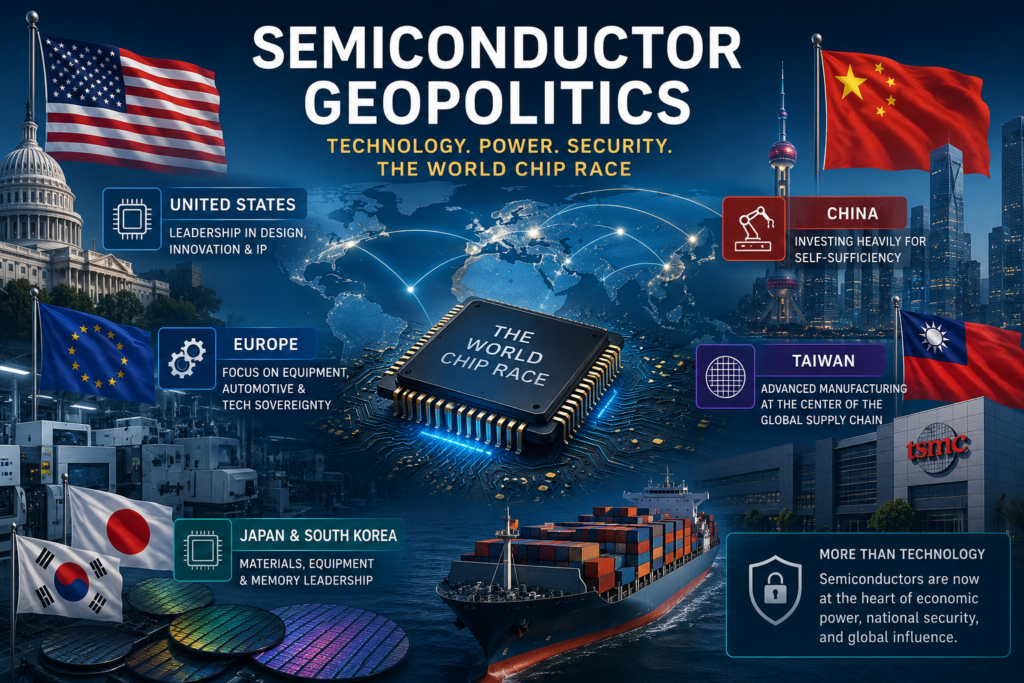
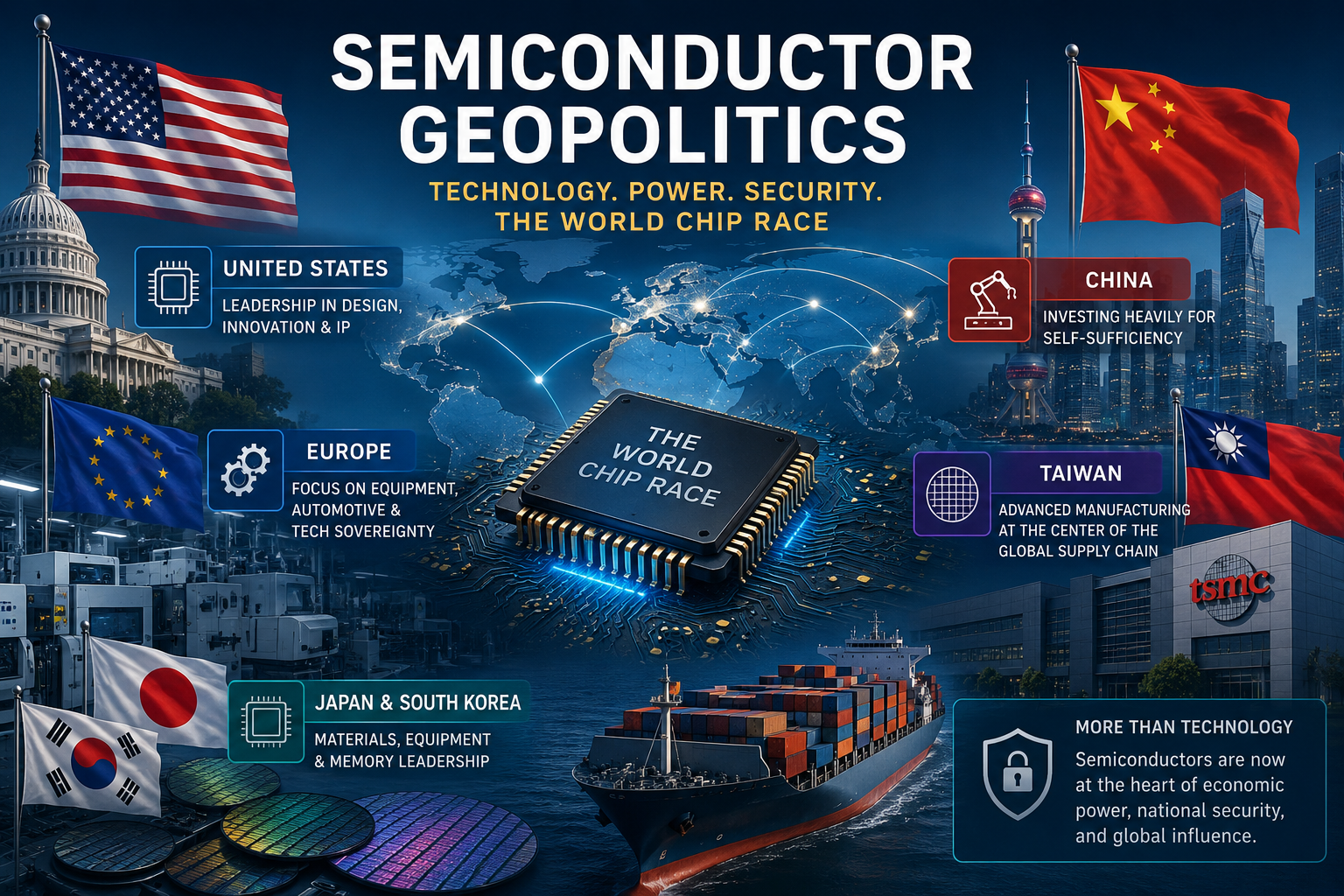
Taiwan occupies a uniquely important position within the global semiconductor ecosystem. The island has become a central hub for advanced chip manufacturing, supplying critical components used by companies and industries around the world.
Its manufacturing capabilities are particularly important for cutting-edge chips required in artificial intelligence, high-performance computing, advanced smartphones, and emerging technologies
This concentration of production has generated both efficiencies and vulnerabilities.On one hand, Taiwan’s expertise has helped drive global technological innovation.
On the other hand, dependence on a limited number of production centers creates risks associatedwith natural disasters, supply disruptions, and geopolitical tensions.
Consequently, developments involving Taiwan are closely monitored by governments, businesses,and investors worldwide.
The United States and Semiconductor Strategy
The United States remains a leading force in semiconductor design, research, software development,and advanced innovation.
American companies continue to play a central role in
• Chip architecture
• Electronic design automation Software
emiconductor equipment
Artifical intelligence hardware
Advanced computing technologies
Recognizing the strategic importance of semiconductors, policymakers have increasingly focused on strengthening domestic manufacturing capabilities.
Efforts include:Expanding fabrication capacitySupporting research and developmentEnhancing supply chain resilienceEncouraging investment in advanced manufacturingThese initiatives reflect broader concerns about technological competitiveness and national security.
The United States seeks not only to maintain leadership in innovation but also to reducevulnerabilities associated with external dependencies.
China’s Semiconductor Ambitions
China views semiconductor development as a critical national priority.
As one of the world’s largest consumers of semiconductors, China has long depended on imports formany advanced chips. This dependence has encouraged efforts to strengthen domestic capabilitiesacross the semiconductor supply chain
Chinese investments have focused on
• Manufacturing capacity
• Research and development
• Talent development
• Equipment production
• Supply chain integration
The objective is to increase technological self-reliance while supporting broader economic modernization goals.
Despite significant progress, challenges remain. Developing cutting-edge semiconductor capabilities requires advanced expertise, sophisticated equipment, and extensive research infrastructure.
The pursuit of semiconductor self-sufficiency has therefore become a long-term strategic undertaking.
Europe’s Position in the Global Chip Race
Although Europe does not dominate advanced manufacturing to the same extent as some Asian economies, it possesses strengths in:
• Semiconductor equipment
• Industrial electronics
• Automotive technologies
• Research institutions
• Specialized manufacturing
European governments have increasingly emphasized technological sovereignty and supply chain resilience.
Initiatives designed to expand semiconductor capacity reflect concerns about dependence on external suppliers and the desire to strengthen Europe’s position within future technology markets.
The European approach often combines industrial policy with broader objectives related to economic competitiveness and strategic autonomy.
The Role of Japan and South Korea
Japan and South Korea remain among the most influential actors in the semiconductor industry.
Japan continues to play a vital role in materials, manufacturing equipment, and specialized technologies. Its industrial expertise supports numerous stages of global semiconductor production.
South Korea has established itself as a major center for memory chip production and advanced semiconductor manufacturing. Its companies contribute significantly to global supply chains serving consumer electronics, computing, and data infrastructure.
Both countries are investing heavily to maintain competitiveness amid intensifying international competition.
Their continued importance demonstrates that semiconductor leadership depends on a diverse ecosystem rather than a single dominant player.
Semiconductor Supply Chains and Economic Security
One of the most significant lessons of recent years has been the vulnerability of highly complex global supply chains.
Semiconductor shortages revealed how disruptions in one segment of production could affect industries worldwide.
Automobile manufacturers delayed production.
Consumer electronics companies faced inventory challenges.
Industrial sectors experienced operational disruptions
These events encouraged governments to reconsider assumptions regarding efficiency and resilience.
Increasingly, policymakers seek to balance the benefits of globalization with the need for greater supply chain security.
This shift has become a defining feature of contemporary semiconductor strate
Industrial Policy and Government Intervention
The global chip race has led to a resurgence of industrial policy.
Governments are using various tools to strengthen domestic semiconductor ecosystems, including:
• Public investment
• Research funding
• Tax incentives
• Infrastructure development
• Workforce training programs
• Strategic partnerships
Supporters argue that semiconductors are too important to leave entirely to market forces.
Critics caution that excessive intervention could reduce efficiency and encourage duplication of resources.
Regardless of perspective, state involvement in semiconductor development is likely to remain a prominent feature of global technology policy.
Semiconductors and Artificial Intelligence
Artificial intelligence has significantly increased the strategic value of advanced semiconductors.
Modern AI systems require enormous computational resources. Training and deploying sophisticated models depend on specialized processors capable of handling vast amounts of data.
As AI becomes increasingly important across economic and security domains, access to advanced chips becomes equally important.
This relationship has intensified competition for technological leadership.
Countries that possess both AI expertise and advanced semiconductor capabilities may enjoy substantial advantages in innovation and economic growth.
Consequently, semiconductors have become a critical component of broader AI strategies.
National Security Dimensions
Semiconductors play an essential role in modern defense systems.
Applications include:
• Communications infrastructure
• Intelligence systems
• Satellite technologies
• Autonomous platforms
• Cybersecurity tools
• Precision-guided systems
Because of these applications, semiconductor capabilities increasingly influence national security planning.
Governments are therefore paying closer attention to supply chain vulnerabilities, technological dependencies, and strategic risks.
The intersection of technology and security has transformed semiconductors into a central issue within international relations.
The Future of the Global Chip Race
Several trends are likely to shape the future semiconductor landscape.
Greater Geographic Diversification
Countries are seeking to reduce concentration risks by expanding manufacturing capacity across multiple regions.
Increased Investment
Public and private investment in semiconductor infrastructure is expected to remain substantial.
Continued Technological Competition
Competition for leadership in advanced manufacturing, AI hardware, and next-generation chips will likely intensify.
Supply Chain Resilience
Resilience will become an increasingly important objective alongside efficiency.
Emerging Technologies
Quantum computing, advanced AI systems, autonomous technologies, and next-generation communications networks will create new demand for sophisticated semiconductor solutions.
These trends suggest that semiconductors will remain a central element of global strategic competition.
Conclusion
Semiconductors have evolved from specialized industrial components into one of the most strategically important technologies of the modern era. Their influence extends across economic development, technological innovation, national security, and international politics.
The global chip race reflects broader transformations within the international system. Governments increasingly view technological capabilities as essential elements of national power, leading to greater investment, industrial policy, and geopolitical competition.
At the same time, the semiconductor ecosystem remains deeply interconnected. No single country controls every stage of production, and international cooperation continues to play a crucial role in innovation and supply chain stability.
The future of semiconductor geopolitics will therefore be shaped by a delicate balance between competition and interdependence. How governments manage this balance may significantly influence the trajectory of technological development and global power dynamics throughout the twenty-first century.
As artificial intelligence, advanced computing, and emerging technologies continue to expand, semiconductors will remain at the heart of the global technological landscape. The nations that successfully navigate the opportunities and challenges of the chip race will help define the next era of economic and strategic leadership.